🦈 Rulers of the Ocean: The Great White Shark Encyclopedia
An ultra-comprehensive documentation divided into 50 in-depth subtopics regarding the anatomy, hunting behavior, ecology, distribution, and challenges faced by Carcharodon carcharias.
✏️ Written & Curated by the Atechsur.org Marine Science Team | Last Updated: March 27, 2026

No other marine creature triggers a mix of awe and human fear quite like the Great White Shark (Carcharodon carcharias). Often heralded as the king of the ocean, this massive predator is one of the largest living macro-carnivores on Earth today, roaming almost all coastal waters from cool to warm tropical temperatures.
Behind its frequently misunderstood reputation fueled by pop culture (such as the movie Jaws), the Great White is actually an animal of high intelligence, incredibly complex sensory systems, and plays a highly vital role—as an apex predator—in maintaining the balance of the marine food web. Unfortunately, its existence in the oceans is now hanging by a thread due to human activity.
- Warm-Blooded (Regional Endothermy): Unlike most fish, the great white can regulate its core body temperature to be warmer than the surrounding water.
- Layered Teeth: They can have up to 300 serrated teeth at one time and can lose and regrow tens of thousands of teeth throughout their lifetime.
- Deep Blue Eyes: If observed closely, a great white’s eyes are actually a very dark navy blue, not pitch black.
- Not Entirely White: The name “White” refers only to its ventral (belly) side. Its back is a dark grayish-blue for camouflage (countershading).

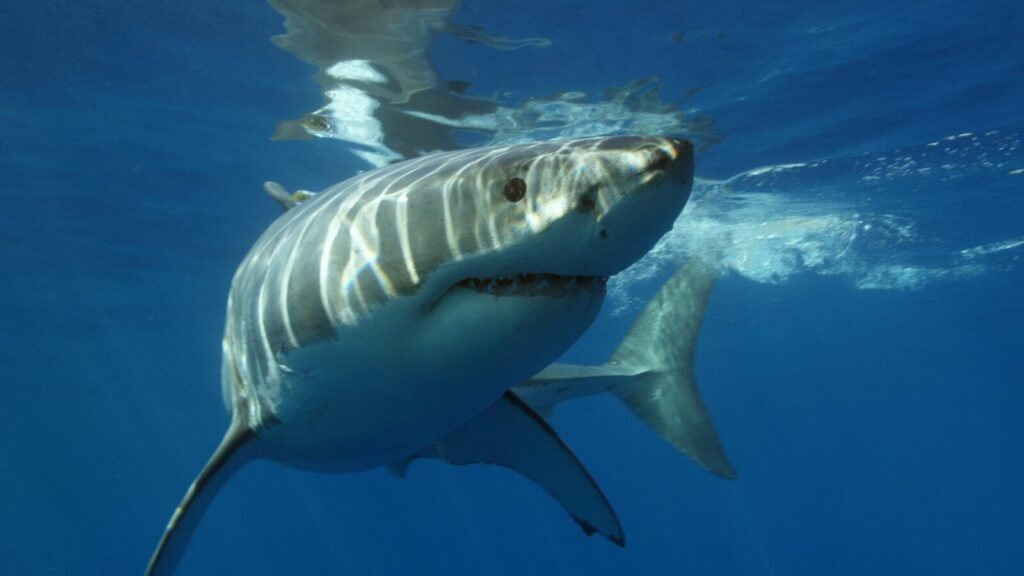
Showing the proportion of the conical snout and classic torpedo silhouette.
This amazing species was first recognized in Western science and given the scientific name Squalus carcharias by the father of modern taxonomy, Carl Linnaeus, in the tenth edition of his book Systema Naturae in 1758. At the time, Linnaeus grouped many types of sharks into one large genus, Squalus.
As ichthyology evolved, this naming was deemed imprecise. Later, the name was independently revised by Sir Andrew Smith to Carcharodon carcharias in 1833, a name that endures to this day.
The choice of the genus Carcharodon was not without reason. The term is deeply rooted in Ancient Greek. The word “karcharos” (κάρχαρος) can be roughly translated as sharp, jagged, or rough. Meanwhile, “odous” (ὀδούς) literally means tooth.
So, when combined, Carcharodon describes the most prominent and lethal anatomical feature of this animal: “Sharp Jagged Tooth”. This name perfectly captures the morphology of their chewing apparatus, which evolved specifically to slice through large chunks of flesh, rather than just swallowing fish whole.
In the marine family tree, the Great White belongs to the family Lamnidae, an elite group often referred to as mackerel sharks. This family includes sharks designed for high-speed swimming in the open ocean, such as the mako shark and the salmon shark.
The hallmarks of the Lamnidae family are a robust, torpedo-like (fusiform) body shape, exceptionally wide gill slits, and a caudal peduncle (tail base) that has “keels”—small lateral fins that function to stabilize their movement when they reach high speeds.
For many years, the general public (and even many early paleontologists) firmly believed that the great white was a miniaturized version or a direct descendant of the giant prehistoric shark, the Megalodon (Otodus megalodon). This gave rise to the old name Carcharodon megalodon.
However, phylogenetic research, analysis of ancient tooth root structures, and modern molecular data have dismantled that theory. The Megalodon is now classified into a separate extinct family (Otodontidae) under the name Otodus megalodon. The great white shark and the Megalodon are merely distant cousins that shared an ancestor in early prehistory but embarked on vastly different evolutionary paths.
If not a descendant of the Megalodon, then where did the Great White Shark originate? The answer was found in transitional fossil teeth. Paleontologists now agree that the modern great white evolved from a lineage of prehistoric mako sharks, specifically a species known as the broad-toothed mako shark (Carcharodon hastalis or sometimes called Cosmopolitodus hastalis).
C. hastalis had broad, triangular teeth without serrations. Millions of years ago, as early marine mammal populations emerged and became a tempting food source, the ancestors of the great white began to adapt. Their teeth slowly evolved fine serrations along the edges, allowing them to transition from agile fish hunters into highly efficient cutters of blubber (mammal fat).

Photographed in 1887. There are no “true bones” in this skeleton, only preserved calcified cartilage.
One of the greatest anatomical marvels of the Great White (and all other Elasmobranchii species) is the fact that they do not possess a single hard bone in their bodies. Its entire structural skeleton is made of cartilage—the same strong yet flexible tissue that forms the tip of the human nose and outer ears.
This absence of hard bone provides a massive evolutionary advantage. Cartilage is much lighter (less dense) than true bone, reducing the overall body mass burden so the shark expends less energy to avoid sinking.

Showing the cartilaginous spinal column and fin supports for sharp maneuvers.
Beyond being lightweight, the cartilaginous skeleton provides an extraordinary level of flexibility. When hunting a highly agile, zig-zagging seal, the Great White can twist its body at extremely sharp angles, a movement that would risk breaking bones if it had a rigid skeleton.
But how can cartilage support a body weighing 2 tons? The solution is a process called tessellated calcification. In areas requiring extra structural strength, such as the upper jaw, lower jaw, and vertebrae, the shark deposits calcium salts in small hexagonal blocks, creating a framework that is as hard as true bone on the surface, yet remains light and flexible at its core.
Most vertebrate animals, including humans, have an upper jaw permanently fused to the cranium (skull). Conversely, the Great White Shark’s upper jaw is unfused. The jaw is only attached to the base of the skull by strong elastic connective tissue and ligaments.
This terrifying design has a specific function: when the Great White opens its mouth to bite a large prey, the upper jaw can detach from its resting position and be thrust forward and out of the mouth. This “protracting” motion ensures the first row of teeth instantly locks onto the target’s flesh before the prey has a chance to dodge away.

Triangular tooth structure with fine serrated edges; evolved like a serrated butcher knife for a sawing action.
The shape of the Great White Shark’s teeth is a specialization for cutting thick flesh (macrophagy). The upper teeth are broad, thick isosceles triangles with a solid base, and possess coarsely serrated edges just like a top-tier steak knife.
Serving a different function, the teeth on the lower jaw tend to be slightly more slender and pointed. When biting, the lower teeth will pierce first to grip the prey so it doesn’t escape like a giant fork, only then does the upper jaw follow, slamming down like a guillotine blade, slicing off chunks of meat cleanly.

Replacement teeth lie flat behind the inner gums, ready to move forward and replace any lost tooth in the front row.
Shark teeth are not embedded in solid bone sockets in the jaw; rather, they are embedded only in soft membranous tissue (gums). Because they frequently bite into hard bones or struggle against thrashing prey, their teeth naturally break or dull easily.
Evolution solved this with a conveyor belt system. A Great White can have up to 5 rows of teeth behind the functional front row. If a front tooth is lost, the replacement tooth behind it will shift forward and stand upright to fill the empty space in just a few weeks. A single great white can go through 20,000 to 30,000 teeth over its lifespan.

Even a medium-sized individual can easily exceed the length of an adult human with outstretched arms.
The myth of the Great White’s size was often exaggerated in past literature, sometimes claiming lengths of up to 10 meters. In verified scientific studies, this species exhibits strong sexual dimorphism, where females grow significantly larger and heavier than males.
Adult male sharks generally measure 3.4 to 4.0 meters (11-13 feet) in length and weigh 520–770 kg. Meanwhile, adult females can reach between 4.6 and 4.9 meters (15-16 feet) weighing 1,500 to 2,200 kg. Giant females exceeding 6 meters (20 feet) are very rarely found, but their existence is valid, evidenced by sightings of the legendary giant shark dubbed “Deep Blue”.

Gray on top (blending with the deep sea) and white on the bottom (camouflaging with surface sunlight).
The body color of the Great White Shark is a masterpiece of stealth hunting adaptation, utilizing a biological coloration concept called countershading. True to its name “Great White”, their ventral (belly) side is a brilliant pale white. However, the area from their back to their flanks is usually grayish-blue, dark copper, or faded black.
If a seal looks up from below the water, the shark’s white belly will blend with the bright sunlight breaking through the surface waves. Conversely, if the prey looks down from a cliff or the shore, the shark’s dark back will blend perfectly with the dark color of the reef or deep sea abyss, making it practically invisible as it glides over the ocean floor.
What looks like smooth, dolphin-like skin from a distance is actually a highly lethal micro-defense layer. The Great White Shark’s skin is not covered in round, slimy scales like reef fish, but by structures called dermal denticles (placoid scales), which are literally microscopic mini-teeth cloaking its entire body.
These denticles overlap and point backward toward the tail. This design drastically minimizes hydrodynamic turbulence and drag as water passes over its body, allowing the shark to accelerate silently (silent swimming) and cut through currents more efficiently. In the prehistoric seafaring era, this rough skin was used like sandpaper (shagreen) to smooth the wooden masts of ancient boats.
Seawater has an incredible capacity to absorb heat, causing most marine creatures to be cold-blooded (ectothermic) as their body temperature matches the environment. Herein lies the Great White’s exceptional trait; it is a regional endothermic creature.
Through a complex, dense network of veins and arteries called the rete mirabile (“wonderful net”), the great white can reabsorb the body heat generated by the contractions of its red muscles while swimming, rather than losing it through the gills. This maintains the core temperature of its vital organs, brain, stomach, and eyes up to 14 °C (25 °F) warmer than the icy ocean surrounding it, giving the shark an immense advantage in terms of stamina and extended high-speed sprints.

The small black dots resembling pores on the tip of the nose (rostrum) are the gateways to the Ampullae of Lorenzini sensors.
The Great White’s killing instinct does not rely solely on its sense of smell for blood. At the tip of its snout and surrounding its head are gland pores filled with a thick, conductive gel directly connected to a neural network called the Ampullae of Lorenzini.
These are electroreceptors that can detect microscopic electromagnetic fields in the water emitted by other living creatures. Even the bioelectric voltage from the heartbeat of a frightened fish hiding in the sand can be picked up by this deadly radar. This sixth sense is vital, especially in the crucial milliseconds before the jaws snap shut, when the shark’s eyelids roll back for protection.
The Great White Shark possesses dark, deep blue eyes with superior optical contrast sensitivity suited for the dim environment of the deep ocean (scotopic vision). However, unlike other reef sharks such as the Tiger Shark, the great white does not have a thick nictitating membrane (a translucent third eyelid) to protect its vulnerable corneas.
To compensate, exactly one crucial second before its snout strikes and impacts its prey—which may fight back using razor-sharp claws—the shark will rotate its entire eyeballs (ocular roll) backward into the skull sockets. By sacrificing its vision during the final second, the shark presents the hard, thick, white sclera from inside its head as a biological protective shield against eye destruction.
Great Whites are highly adept at extreme long-distance scent tracking. Scientific facts state that the olfactory bulb (the zone of the brain lobe responsible for receiving and processing scent sensors) takes up nearly 14% of the shark’s proportional brain mass.
They are capable of catching the scent of a single drop of blood—or extracts from fatty, blubbery prey—dissolved in a hundred billion gallons of seawater (extending up to an astonishing radius of 4.8 km or 3 miles, depending on ocean currents). Once the scent trail is locked on, the shark executes a clinotaxis maneuver—swinging its head left and right while swimming up the dense “scent plume corridor” to guide it exactly to the bleeding source.
In blind-visibility conditions during murky, turbulent storms or pitch-black nights, the eyes cannot be relied upon. Like other elasmobranchs, they are equipped with an extra sensory monitoring organ along the left and right flanks of their body down to the base of the tail, known as the Lateral Line.
This hydraulic neural system reacts instantly the moment it picks up pressure distortions or physical wave frequencies caused by the slightest splash of a prey fish’s tail (or the rhythmic swimming waves of a wounded prey). The shark can pinpoint the exact position from hundreds of meters away before the object even comes into visual range.
Strongly contradicting the archaic scientific theory that large predatory shark species were merely endemic, offshore coastal creatures, modern satellite tag tracking has unveiled their globe-trotting patterns. Great Whites are confirmed to undertake highly heroic pelagic ocean migrations, traversing continental divides.
The most massive discovery was documented by the movements of a phenomenal female named “Nicole”; she swam round-trip between the seal-dense coast of False Bay in South Africa and successfully reached the distant coastal areas of Western Australia, completing a total geomagnetic navigational leg of roughly 20,000 kilometers in just under nine months.
Scientists have long pondered how a shark manages to traverse vast, ancient, featureless oceans (with no visual coastal landmarks) with absolute navigational accuracy to reach isolated archipelagos.
It is believed the Great White senses the Earth’s geomagnetic field lines as an astonishing internal biological GPS. The super-sensitive electrical wave detectors (Ampullae of Lorenzini) are claimed to detect the orientation and gradients of geomagnetic polar maps as the shark cuts through pelagic belts across international ocean borders.
At birth, the young great white’s first instinct focuses its diet on lighter marine fare; they are primarily carnivorous upon schools of small spiny-finned fish (teleosts) and cephalopods like octopuses and squids, or small-bodied demersal sharks and rays.
Upon entering the sub-adult phase and maturing into adults (crossing the giant size parameter beyond the 3-4 meter length limit), their tooth profile broadens. Their jaw type completely evolves and shifts to digest heavy meals; predominantly dominated by thick, high-calorie fat from marine mammals, such as elephant seals, Sea Lions, seals, rotting carcasses of colossal fallen whales, or specific large, high-speed pelagic fish (giant bluefin tuna or marlin).

Ambushing a bait target from the dark depths towards the glaring surface area.
The ultimate ambush tactic of the Great White—most intensely observable on a daily basis specifically around Seal Island, False Bay—is technically known as the “Polaris Attack” (or the flying “breaching” style).
The predatory shark stealthily swims near the bottom zone of the colony, roughly 15 to 20 meters deep in the pitch-black mid-water column, perfectly camouflaged (under-shadow patrol). When a target seal at the surface appears isolated, careless, and off-guard, the shark unleashes explosive torque from its tail thrust, sprinting sharply straight up to the surface at a savage acceleration speed approaching 56-64 kilometers per hour.
So tremendous is the inertial momentum of this vertical launch that when the giant’s nose and jaws collide and strike the prey, the entire body weight of the two-ton predator can be launched completely into the air, arcing fully into the sky with fangs locked onto the victim before crashing back down, tearing through the rippling sea foam.
This rare kinetic aggression of phenomenal breaching is recorded as one of the most attractive staple sights in modern global marine wildlife photography.

Avoiding prolonged resistance after delivering one fatal, capable wound to the thick back area of a seal mammal.
When targeting tough, capable mammals armed with sharp fangs and claws—such as mature Elephant Seals—the shark tends to avoid the risk of prolonged, close-quarters combat and potential injury.
Its primary “strike” calculation system adopts the Bite-and-Spit mode. The shark lunges, delivering a devastating bite that creates a massive, fatal arterial tear, and then immediately releases the victim. The killer waits, pulling back to a safe distance, passively stalking in circles, observing the target weaken and eventually die a slow, tragic death from total exsanguination (massive blood loss).

They are densely concentrated only along specific temperate latitude coastal belts.
This amazing species does not randomly or evenly occupy dense distributions across all bodies of water on Earth. They are heavily clustered in specific population pockets (dense colony areas supporting their food web). Three legendary global concentration areas with the highest great white sightings are recorded along the western Atlantic Ocean coastline of the United States, from Cape Cod on the East Coast of Massachusetts down to the Florida line.
Then, there is the prominent Pacific epicenter of the Farallon Islands off the coast of northern California (the Red Triangle sea area) and the archipelago of Guadalupe Island off the western coast of the Mexican peninsula (Baja). Furthermore, the Indian Ocean epicenters in the gulf zone of Gansbaai, the False Bay area in South Africa, and the southern hemisphere oceanic corridor of South Australia centered around the Spencer Gulf Neptune Islands down to New Zealand.
General public stigma is heavily influenced by cheap, panic-inducing journalism or popular horror fiction from Hollywood, such as the post-70s cinematic blockbuster trilogy (Jaws released in 1975). This fictional movie proved cruelly effective at slandering and totally discrediting the animal that regulates the oceans, portraying it as a blood-crazed, sadistic demon monster obsessively seeking human flesh as its primary diet.
Absolute empirical scientific data blatantly rejects this fallacy. The biological, anatomical, and genetic profile of the Great White shows virtually zero response or interest in incorporating human tissue, bone structure, or nutrition into its daily palatability (menu) scale. The number of fatal human casualties resulting from shark bite attacks worldwide is so marginally trivial (roughly a few dozen non-fatal global cases annually) that it ranks far below deaths caused by sudden natural lightning strikes or attacks by domestic communal animals like cows or dogs.
Why do incidents of humans getting bitten by this predator still occur occasionally? The answer points to a visual misidentification (Mistaken Identity) caused by the optical illusion of a surfer’s silhouette traversing the ocean waters.
The contrasting dark silhouette of a short or long surfboard, paddled by two swimming arms and kicking legs, viewed against the bright, glaring surface waves backlit by the sun from the perspective of the shark’s lens down in the dark, murky oceanic abyss—perfectly and 100% accurately represents the exact replica of the predator’s primary savory prey (the body of a sea turtle or a free-swimming seal colony).
Once a shark executes an investigatory sensory attack, launching a brief identification test bite (“exploratory bite”)—to gauge whether what is in its mouth is a delicious, blubbery seal or not—its taste receptors immediately sense the hard texture of a wetsuit, the rubber ratio of a board, and the stiff, bony structure of human limbs, which are incredibly poor in the high-calorie, thick fatty meat oil its digestion requires.
After this sensory recognition of disappointment and disgust, the shark hastily and reluctantly releases the victim, turning away and swimming off from the surfer (rather than tearing and continuing to chew on them multiple times). The victims who tragically die are almost never consumed or swallowed into the shark’s stomach; rather, they succumb to pure fatal exsanguination (bleeding out) and shock following that initial test bite.

Operators use a rubber seal model dragged on a line as an entertainment lure for observers safe on the boat.
The negative image has slowly and drastically been transformed into an economic powerhouse for billion-dollar marine ecotourism. Legendary areas like Gansbaai or the coastal reefs of South Australia’s Neptune Islands are famous for operators servicing the anti-shark bite steel cage diving industry (Shark cage diving).
Amateur, inexperienced tourists are placed inside a secure steel cage in cold waters while a team on the outer deck lures the magnificent creatures to approach for close, intimate eye-contact encounters. This completely shifts the spooky, mystical perception into an appreciation for marine beauty and protection.

Throwing broth of chopped fish meat and oil to spread its scent corridor range for the radar.
Ecotourism operators generally cannot simply sit quietly and wait for the natural, coincidental luck of a passing shark to friendly greet a docked boat. They actively employ a recipe and pouring technique of bulk fish pellets known as “Chumming”.
Chumming involves a mashed broth of fish guts, factory scraps, and fatty meat from commercial pelagic fish like sardines/tunas, mixed with thick, spilled sardine oil, soaked and poured from the stern into the sea. This creates a “scent trail corridor” carried by the wind and currents, spreading miles away to entice the nose. Simultaneously, physical bait (Baiting)—often a dead tuna head tied to a rope—is tossed and pulled along the surface, guiding the shark upwards (surface level) to provide spectacular visual silhouettes for tourist cage photographers.
Despite carrying a sentiment of love, appreciation, and conservation education, fierce academic debates on ethics have never faded. Research scientists worry about the long-term impact of the tradition of chumming attractions, fearing it alters the pure, primitive, natural behaviors of these independent, nomadic creatures.
It is suspected they are becoming conditioned with a Pavlovian boat-association behavior, reflexively approaching motorized tourist boats desiring free handouts of light snacks, instead of actively patrolling with their wild mammalian killer instincts. Criticism from local beach surfing practitioners strongly protests that chumming near shallow city borders provokes an increased frequency of stray shark aggression near recreational beaches. However, historical data monitoring has not yet provided sharp, conclusive parameters of a direct, fatal causal correlation to fully back that theoretical claim.
In the world of Carcharodon carcharias, males (bulls) do not hold the pinnacle of dominant, superior physical supremacy in the oceanic colony. This primitive, robust species follows the rule of “Sexual Dimorphism,” where the genetic size of the female shark vastly outstrips the male, holding the absolute heavyweight title.
Normal mature males generally hit a dimensional weight barrier roughly half the size, with a rational limit of about 3.4 to a maximum of 4 meters. Strong, prime females can grow freely to forge colossal total lengths (Total length) of 4.8 meters, easily breaking through the extreme 6-meter super limit. Legendary ancient, majestic females, like the tracked icon named “Deep Blue,” rule the throne of photographic records with estimated body mass volumes pushing records well over a thick 2 tons.
How long and old does the ruler of the ocean survive and breathe? The latest radiocarbon isotope detection methods, reading the banded ring fibers of their vertebrae bones, refute older laymen’s estimates that assumed a lifespan of merely 3 decades.
Evolution proves that large sharks follow a life strategy of slow-growing, late-maturing, calm aging. The successful maximum lifespan of a male is projected to surpass 73 years, while the projected life expectancy of matriarch female sharks is confirmed to age and roam the oceans up to a peak limit of 40 to 70 decades, aging peacefully.
The biggest challenge in the conservation and ecological recovery of the white shark lies absolutely in the extreme slowness of their biological and genetic puberty cycles. This apex predator does not mate and reproduce rapidly or carelessly. Their juvenile period stretches extensively over 20 long decades.
Alpha males only enter puberty and maturation after 26 years since birth. Meanwhile, matriarch females can only fully produce reproductive ovum capacity when their physical criteria reaches the peak of aging at 33 years of extreme, slow biological maturity. This fragile and threatened level of productivity becomes a fatal weakness when their populations are culled, killed, and wiped out by fishing nets eagerly hunting commercial fish, taking them out during their mature years before completing their first pregnancy.
The uniqueness of the brutal killer gene chain occurs even before they touch the external marine environment of their birth. Shark mothers do not casually dump their vulnerable, external-shelled eggs to be scattered defenselessly over dead grass or reefs; this tough, cruel species exclusively carries its eggs purely within a protective, warm embryo tube (ovarian womb) inside the mother’s body (a reproductive category called Aplacental Viviparity / Ovoviviparous).
The superior, fast-maturing, agile shark pup embryos that hatch their internal shells first will instantly exhibit intra-carnivorous predator action; the ravenous embryos will completely devour, clear out, and swallow whole the supply of unfertilized, failed-to-develop sibling eggs (a biological instinct of womb cannibalism: Oophagy). This accumulates nutritional capital and tough, muscular body mass so they are instantly capable of diving and sprinting competitively to eliminate their first opponents the second they glide out into the vast expanse of the real open ocean (litter births are minimal, averaging only 2 to 14 total pup specimens).

An albino pup (baby great white shark) accidentally caught in 1996 off the coast of Boknesstrand, Eastern Cape, South Africa.
In human history, genetic pigment disorders like albinism (achromelanism or pure, 100 percent total pale true leucism) in large shark species is a hyper-rare occurrence worldwide, because such anomalies generally greatly reduce the survival potential (ruining the camouflage concept) of baby sharks.
The archival photo above is one of only a handful of undeniable pieces of evidence regarding the existence of a Carcharodon carcharias pup that possesses an entirely snow-white coloration. This unfortunate albino youngster was caught in a coastal seine net in the Eastern Cape of Africa and preserved whole as an irreplaceable specimen in a zoological museum for the purposes of marine medical biology and educational observation.
The population status of this marine giant is languishing, having plummeted terribly from being merely abundant and thriving decades ago in the twentieth century, now dropping to the edge of the Red zone classification (Vulnerable – threatened with rapid population decline) as designated by the panel board of the international environmental conservation authority, the IUCN Red List, on an absolutely aggregate, global scale.
The escalation of the collapse in their biological regenerative survival numbers is deeply concerning, compounded by various fatal, modern problematics: accidental death by drowning in nets (offshore industrial pelagic bycatch), thinning ecosystem food chain competition, degradation of coastal corridor waste, the exploitation of jaws for fisherman trophy aesthetics and the barbaric (finning) gill soup black market on the Asian economic mainland, as well as chain-terror attacks by ecological competitor pods (orca whales) completely sabotaging their original local water hotspots.
A dramatic image of a Great White Shark trapped in the ocean. Hundreds of young adult populations suffocate helplessly every year tangled in gillnets.
It is not the spear of the hunter or the sadistic hunting hook that threatens the slow, creeping extinction of this magnificent species, but rather the commercial fishing industry’s nets. Sharks must manually pump marine water (ram ventilation) by swimming constantly forward, pushing water through their gill slits so they can swallow the irreplaceable oxygen exchange for blood circulation to stay alive.
When the robust, giant head of a white shark accidentally forces its way in and becomes tangled (Tangled) across the towing lines of commercial sardine/tuna seines (industrial drift/gillnets from massive pelagic factory ships), this static halt in movement instantly and practically clogs their breathing circulation, causing suffocation (asphyxia/slow drowning). The grand predator ultimately exhales its final breath not in a valiant, challenging fight, but dies a martyr’s death, tortured by exhaustion, ending up as just a tragic statistic—a marginal victim complementing the fish nets (Bycatch).
Unfortunately for their existence, their entire anatomy is valued in the horrifying, illegal, wild capitalist global black market auction exchanges. The head chunk, the framework of the snout, and perfectly intact, flawless sawtooth jaw sets (Jaw sets mount) are fiercely targeted and ruthlessly hunted extensively, sold on crazy auction forum platforms for millions of dollars to be arrogantly displayed as aesthetic trophies in the private living rooms of powerful collectors and hunters (sports angler trophies).
Furthermore, shark finning murders target the top dorsal fin, the body’s pectoral fins (wings), and the lower tail steering propulsion blades (Caudal fins) to fuel the greedy ambition for raw materials in the luxurious, elite hotel restaurant soup bowl business in certain territories, serving the prestige broth (shark-fin soup) for traditional commercial business banquets.
Tourism anxieties and coastal public swimming safety concerns force local beach security authorities to deploy underwater traps and thick cage knitting to prevent interactions between wild sharks and surfers/tourists. Classic methods (a legacy of the 1930s) include thick, floating, and sinking offshore nets (Shark nets) and baited drum line rigs with bloody meat hooks (Drumlines).
Instead of completely blockading the patrol routes of sharks from swimming beaches, these nets indirectly function merely as massive, brutal fish-killing minefields that hang and kill hundreds of rare marine turtles, stray dwarf orca dolphins, and harmless small sharks at a highly saddening rate, sparking fierce controversy, boycotts, and sharp criticism for dismantling by marine ecological protection agencies from a practical and bio-morality standpoint in today’s modern world.
In the curriculum of the ocean’s royal apex pelagic predator food chain pantheon, no rival dares underestimate the Great White’s sawtooth bite. Except for the absolute intelligence of the wolf-like, dolphin-bodied, highly organized, and fiercely tactical social mammalian hunters: the Killer Whale (Orca: Orcinus orca).
Local migrating Orca clans (documented in an epic, brutal incident involving the Port & Starboard orca pod off the southern False Bay coast of Africa and the reef archipelagos of New Zealand and the northwestern US waters) have been proven to deliberately occupy, slaughter, tackle, and hunt down mature, giant Great White Shark colonies. Orcas possess the advantage of vastly more massive body weight tonnage, the aerial stamina of a dynamic, agile mammalian lung oxygen system, and the command strategy of cooperative, highly intelligent squad communication to surround, ambush, and target the shark’s weak fin points.
Orca pods exploit the shark’s primary biological neurological vulnerability called the reflex sensor weakness (Tonic Immobility / a trans-catatonic relaxation seizure paralysis). Orcas deliberately slam, swim, and violently ram the shark at high speed from the lower side angle, rotating the shark’s back until it flips completely upside down, exposing its belly, causing it to fall into an unconscious, statically paralyzed, sudden faint like a block of wood.
While the shark lies gaping and stiff, unable to parry, the orca’s precisely fanged snout operates, excavating and surgically slicing the chest and gills, tearing the victim’s carcass solely to discard the gut contents, squeezing and clawing to extract, suck out, and ravenously devour the massive, intact chunk of high-calorie Squalene oil energy (Liver Extraction). Once the internal organ is neatly extracted and fully consumed, the rest of the entire physical carcass, meat, and skeletal body of the unwanted shark is tossed away, floating and sinking as waste debris into the dark abyss of the ocean trench.
The deadly Orca attacks carve a chemical water residue trauma, causing a massive, prolonged, cascading domino ecological effect on the stability of the local hunting hotspot shark colony habitats.
The release of the rotting, ammonia-laced blood compounds from the destroyed liver of the unfortunate sunken shark victim (or the biological alarm vibrations of communal peers), triggers a hysterical “red alert” panic, a massive “flight and fright” exodus among the neighboring local shark colonies. The entire remaining survivor population (hundreds of combined mature and juvenile great whites in the vicinity) are recorded to instantly cancel their hunting rotation activities, conducting a sudden, urgent mass evacuation of the area. They vanish completely, not daring to show their faces on patrol (the absent / Flight effect phenomena) from the coastal spots for months into the future, or even boycotting and leaving the area empty without a predator king for years, causing the death of the tourism cage diving and boat holiday economy.
Caging a wildly independent, continent-roaming giant predator inside a concrete, cylindrical cube exhibition tank for commercial entertainment (Captivity), no matter how expensive or grandiose—costing tens of millions of gallons in volume for international aquarium construction projects—has been absolutely proven repeatedly to fail completely, tragically torturing and hurting the animal’s biology.
Not a single giant zoo or aquarium institution has absolutely succeeded in housing, caring for, and confining a great white shark for a reasonable maintenance period spanning decades or long years. The sharks refuse to eat, going on a passive hunger strike, vomiting, and rejecting meat intake (fatal starvation, depression, and coma) due to the psychological shock of having their electrical navigation sonar field enclosed. They bump and crash frustratingly, bruising their snouts against the mica glass of the concrete cage tanks, suffering from severe depression, exhaustion, weakness, and trauma (rare specimens were even recorded surviving tragically for only a dozen to twenty days, or mere hours, in Japanese tanks before their lives perished).
To suppress and dampen the storm of blind genocide crimes from apathetic international pelagic longline nets, and addressing concerns over the lack of real demographic population history of global sharks; the marine expert community initiated a series of extensive scientific observation conservation restoration campaigns utilizing modern satellite geo-location tracking tactics (Pop-up Satellite Archival Transmitting Tags / PSAT bio-pins).
By embedding and attaching a mini biological signal antenna tracker cylinder to the dorsal muscle skin fin of the shark, space satellites harvest data, recording and reading the temperature trajectories, position time logs, directional maps of the shark’s daily intercontinental pelagic swimming migration routes with live transmission, without harming or injuring the animal. This is used to urgently formulate and push for the tightening of boundary laws for international marine protection zones (Marine Protected Zones, strict maritime preservation laws).
In order to put the brakes on the plunging curve of extinction status, a handful of proactive ecological protection pioneer countries have enforced legal shields, erecting full protection laws banning all absolute hunting with severe sanctions.
The continental government of South Africa initiated a bold breakthrough early on, laying the milestone in 1991, making it a fully protected, sacred fish, strictly prohibiting hunting. This wave was then replicated by the giant pioneer maritime continent of western Australia, establishing strict sanctuaries, as well as New Zealand. The United States also tightened great white shark hunting protections, specifically on the regional Pacific coast of California through the open Atlantic Ocean, reaffirming the international Convention on International Trade in Endangered Species treaty framework (CITES protection category, placing it in Appendix II with strict trade regulations).
The face of Carcharodon carcharias dominates its terrifying appearance with its elongated, aerodynamic front cone nose structure (Conical snout/bullet-pointed) that sharply solidifies to tear and split the hydrodynamic friction drag of heavy ocean wave currents.
The construction of the nasal cavity and mouth cleft space is asymmetrically positioned, tucked very far and hidden deep in the inferior area (under the chin, belly, and neck), invisible from the front. Because of this centric position, when snapping, crashing, pouncing, clamping, and eating chunks of targets at the surface, the predator is naturally forced to forcibly lift, yank its neck jaws, and arch high towards the sky (snapping the jaw bite lifting upwards) to provide exposure space for the row of axe-like bite ambushes, perfecting the fatal razor wound on its victim in the climatic, lightning-fast split-millisecond duration of its confrontation attack.
The evolutionary transition of the biological anatomical structural mutation timeline of the Carcharodon shark ancestor is documented, brilliantly comprehensively arranged, and archived in the sedimentation plates of the ancient oceanic earth’s geological records.
The archival records of tooth fragments and fossil shark teeth dropped during the ages of millions of years past in the Mio-Pliocene plains record the slow transition trace of the metamorphosis of its sharp knife-edge model shape; showing the shift from the plain, root-neck base structure of the prehistoric C. hastalis Mako ancestor, slowly functioning, mutating, expanding, and growing fine serrated razor saw fibers, thickening its base and wide crown. This transformed alongside the explosion of the ancient marine nutritional prey commodity of oil-rich pinniped mammals (seal lineage), transitioning into the purely modern Carcharodon carcharias tooth structure—a deadly, efficient flesh-slicing shark.
In the most recent decades of the modern marine science, ocean preservation, and biological documentary millennium (especially independent research by pioneer free-diving marine videographers); undeniable recorded evidence is presented, overturning and dismantling the dogma and stereotypical myth of the fierce, vicious, terrifying, uncontrollably brutal, ravenous predator from popular fiction screens (demonization of sharks).
Several daring divers, conservationists, and marine biological interaction experts have successfully proven interactions by diving and navigating without iron cage defenses, swimming freely, peacefully floating, tracing, and interacting amicably, looking into the vast ocean bays of shark territory waters without any shield protection within a touchable range without injury or bite (Open water interaction respectful free-diving). This strongly affirms the scientific thesis that this animal is highly careful, rational, not insane in responding with blind murder, and is highly calculative in its intelligence (not a sadistic monster, but a selective, careful observer hunter, provided human maneuvers remain relaxed, behave elegantly, and are not provocative to trigger weak prey signals near their area, living peacefully in harmony, united side by side, respecting the pure, eternal silence of mother nature’s ocean).
What is the staple diet of Carcharodon carcharias?
Their consumption pattern is heavily dominated specifically towards the nutritional class of animals with dense blubber fat. These mature adult carnivorous species primarily focus on hunting marine mammals such as Sea Lions, seals, and giant, calorie-dense bluefin tunas (as well as small dolphins).
Is the shark truly perfectly ‘white’ all over its back?
Absolutely not! Very different from its fierce moniker in the media, the “White” reference only specifically applies to the skin zone of its ventral underside. The dorsal skin surface of the upper face radiates a dark silhouette of iron blue, bronze, dark steel black, faded copper grey, or pale stone gray, serving as a trick to deceive prey into blending seamlessly and vanishing invisibly into the dark background of the deep ocean coral abyss when viewed from above (a true marine optic military-style stealth countershading gradient trick that is perfectly effective).
Is their pure population ratio out of the critical zone of global extinction and stable today?
It is very wrong to say they are thriving, prosperous, and that their reproductive survival is eternally safe and evenly spread in the 21st century. The population percentage counts from matrix surveys show the numbers of these giant colonies are terribly plummeting, shrinking sadly, eroding into the emergency classification territory (Vulnerable to rapid population decline status on the IUCN Red List). They are sliding, shrinking, cruelly eroded by the impact of wire-netting by-catch, commercial tuna longlines, and the barbaric trophy-hunting vanity and illegal finning black markets in the Asian economic continent, ruthlessly slaughtering the genetic womb diversity of the true ocean ruler—leaving the magnificent prehistoric evolutionary heritage of our universe slowly fading, sadly on the brink of silent extinction without the hope of stable, continuous recovery for the centuries of grandchildren to come.
Explore our trusted network of partner websites covering directories, encyclopedias, marketplaces, education, and finance.
- This digital documentation is created solely as a basic reference material for maritime biology education and the observation of wildlife photographic visual records of the marine animal, without exaggerating baseless monster panics.
- All included image multimedia content is purely distributed from the free open-license directory (GNU/Creative Commons Attribution) belonging to the worldwide Wikimedia Commons open server database and maritime photographers.
- The endangered status ranking of this species refers to the latest verified confirmation released by the official IUCN Red List experts on world conservation.
About the Drafting Team: Atechsur.org Biology Experts
The scientific biology editorial board of Atechsur.org proactively provides accurate, in-depth scientific reports with a dedication to light, humanistic language to break misguided killer monster myths, in order to promote a future of improved ocean conservation and comprehensive, educational ecosystem protection globally.
© 2026 – Atechsur.org – Complete Great White Shark Encyclopedia Database (Chapters 1 – 50)
Carcharodon carcharias • Vulnerable Species • Updated: March 27, 2026