🦈 The Great Hammerhead: Apex of the Ocean
An exhaustive, 15-part encyclopedia documenting the biology, evolution, behavior, and pressing conservation needs of the magnificent Sphyrna mokarran.
✏️ Curated by the Atechsur.org Science Team | Last Updated: March 27, 2026 | Visuals from Wikimedia Commons

The Great Hammerhead Shark (Sphyrna mokarran) is the undisputed giant of the hammerhead family (Sphyrnidae). Cruising through tropical and warm temperate oceans worldwide, this apex predator is universally celebrated for its imposing size—frequently reaching lengths of 15 to 20 feet (4.6 to 6.1 meters)—and its unmistakable profile.
What truly sets the Great Hammerhead apart is its bizarre yet highly specialized head structure, known scientifically as a cephalofoil. Unlike other hammerhead species which feature curved or scalloped front edges, the front edge of the Great Hammerhead’s cephalofoil is nearly perfectly straight. This extraordinary evolutionary adaptation provides superior binocular vision and acts as a massive sensory array, designed to sweep the ocean floor and detect the faint electrical signals of its favorite prey: stingrays buried deep in the sand.
- The Ray Hunter: Great Hammerheads have an incredibly strong preference for stingrays. They use the sides of their wide heads to physically pin a struggling ray to the sea floor before delivering a fatal bite.
- Immunity to Venom: Remarkably, they seem largely unaffected by stingray venom. It is not uncommon for captured individuals to be found with dozens of sharp stingray barbs permanently embedded in their mouths, throats, and digestive tracts.
- Solitary Nomads: Unlike the Scalloped Hammerhead, which is famous for forming massive, swirling schools, the Great Hammerhead is a strictly solitary, nomadic hunter. They are rarely seen in close company with others of their kind outside of mating events.
- Energy-Saving Swimming: Because their extremely tall dorsal fin generates a lot of drag, Great Hammerheads often swim “rolled” at an angle on their side. This asymmetrical swimming style actually increases their hydrodynamic efficiency.

Source: Biodiversity Heritage Library • Early documentation of the species by Rüppell.
The Great Hammerhead was first officially described by the German naturalist Eduard Rüppell in 1837. During his extensive expeditions to the Red Sea, Rüppell collected and cataloged numerous marine species, publishing his findings in Neue Wirbelthiere zu der Fauna von Abyssinien gehörig.
He originally named the shark Zygaena mokarran. The specific epithet mokarran is believed to be derived from an Arabic word relating to its distinctive head shape. Later, the species was moved to the genus Sphyrna, derived from the Greek word for “hammer,” solidifying its modern scientific name, Sphyrna mokarran.

Source: Wikimedia Commons • The hammerhead family is one of the most recently evolved lineages of sharks.
Belonging to the family Sphyrnidae, the Great Hammerhead shares its lineage with eight other recognized species of hammerheads, including the Scalloped Hammerhead (Sphyrna lewini) and the Smooth Hammerhead (Sphyrna zygaena).
Evolutionarily speaking, hammerhead sharks are considered relatively “new” arrivals in the ocean. Fossil records and molecular dating suggest that the unique hammer-shaped head evolved roughly 20 to 25 million years ago during the Miocene epoch. Despite being the largest, genetic studies indicate the Great Hammerhead is closely related to the Scalloped Hammerhead, sharing a recent common ancestor.

Source: Wikimedia Commons • Note the exceptionally high, curved first dorsal fin.

Source: Wikimedia Commons • The wide cephalofoil and towering dorsal fin are instantly recognizable.
The Great Hammerhead boasts a sleek, streamlined body designed for powerful bursts of speed. Its dorsal coloration ranges from dark brown to light gray or even an olive hue, fading to a stark white belly—a classic example of countershading that helps camouflage the predator in the open ocean.
To definitively distinguish a Great Hammerhead from a large Scalloped Hammerhead, experts look at the fins. The Great Hammerhead’s first dorsal fin is absurdly tall and strongly falcate (sickle-shaped). Additionally, the trailing edges of its pelvic fins are distinctly concave, curving inward, whereas other hammerheads have straight-edged pelvic fins.

Source: Wikimedia Commons • The nearly straight anterior margin is the hallmark of this species.
The defining feature of the Great Hammerhead is its “hammer,” or cephalofoil. In Sphyrna mokarran, this structure is particularly broad, taking up nearly 23-27% of the shark’s total body length. More importantly, its front edge is almost perfectly straight, save for a shallow notch right in the middle.
This biological wing serves multiple purposes. It acts as an advanced hydrofoil, granting the shark incredible maneuverability allowing it to turn on a dime. Furthermore, the wide spacing of the eyes provides exceptional binocular vision, depth perception, and a 360-degree view in the vertical plane. Most crucially, the massive surface area is packed with Ampullae of Lorenzini, electroreceptor organs that detect the tiny electrical fields generated by the muscle contractions of hidden prey.

Source: Smithsonian Tropical Research Institute

Broad and heavily serrated for cutting.

Slightly narrower, designed for gripping prey.
Unlike sharks that rely on sheer crushing power, the Great Hammerhead is equipped with a highly specialized set of cutting tools. Their relatively small mouths contain heavily serrated, triangular teeth that are strongly angled toward the corners of the mouth.
There are typically 17 tooth rows on either side of the upper jaw, and 16 to 17 on the lower jaw. This dentition is perfectly adapted for slicing through the tough, cartilaginous wings of stingrays and the bodies of other sharks. When a stingray is pinned to the sea floor by the hammerhead’s cephalofoil, the shark pivots its head to deliver a swift, clean bite, severing the ray’s pectoral fin to immobilize it.

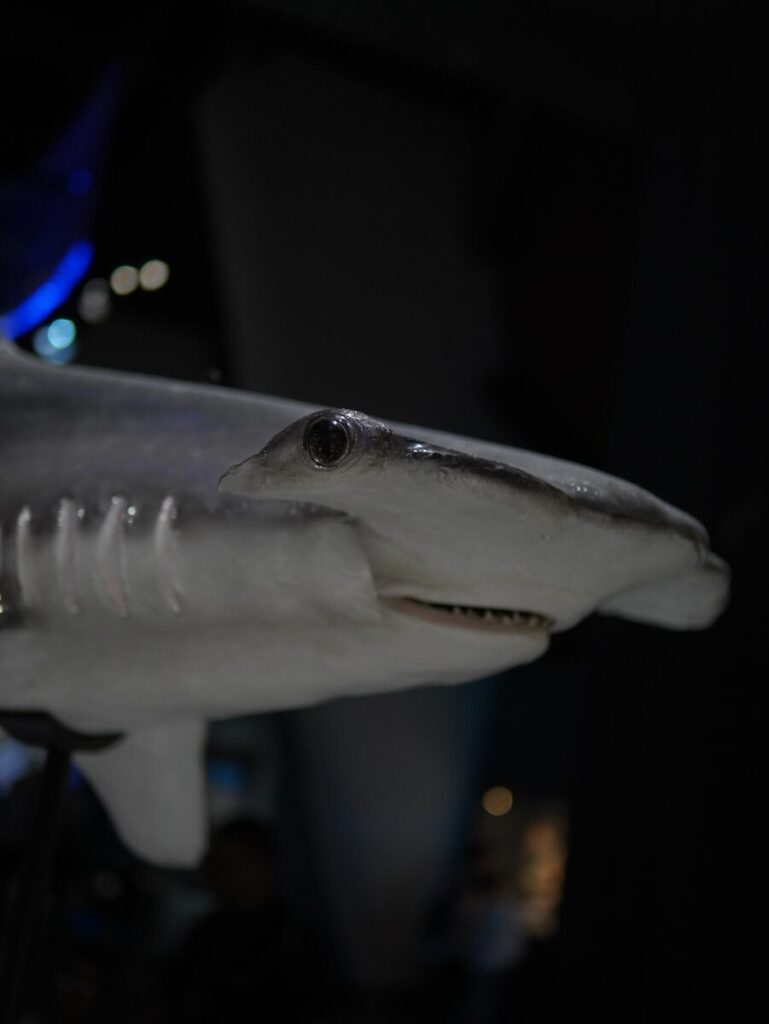
Source: Wikimedia Commons • Preserved for educational display.

Source: Museo de Ciencias Naturales Federico Carlos Lehmann
Because Great Hammerheads are relatively rare and incredibly difficult to study in the wild continuously, museum collections have been vital to understanding their biology. Historic jaws, taxidermy mounts, and fluid-preserved specimens allow researchers to study their skeletal structure, tooth replacement rates, and the mechanics of their jaw suspension.
Institutions around the world retain these specimens, which are often the only way members of the public can grasp the sheer scale of the shark’s jaws without diving into the ocean.

Source: Wikimedia Commons • The shaded areas indicate confirmed habitats across tropical latitudes.
The Great Hammerhead is a circumtropical species, meaning it can be found in a wide belt around the earth near the equator. Its range extends between the latitudes of 40°N and 37°S.
In the Atlantic Ocean, they range from North Carolina to Uruguay, and from Morocco to Senegal. In the Indo-Pacific, their territory spans from the eastern coast of Africa, through the Red Sea, across the Indian Ocean, and deep into the Pacific, reaching places like southern Japan, New Caledonia, and French Polynesia.

Source: NOAA Photo Library • Photographed in the Gulf of Mexico.
While they are strong swimmers capable of crossing deep oceanic basins, Great Hammerheads are fundamentally coastal predators. They exhibit a strong preference for continental shelves, island terraces, and the edges of coral reefs. They are highly adaptable to depth, frequently seen cruising in water as shallow as 3 feet (1 meter) near beaches, but have been recorded diving to depths exceeding 980 feet (300 meters).
The Gulf of Mexico is a critical habitat for the species, offering expansive sandy shallows teeming with their preferred stingray prey. Similarly, the coral atolls of the Caribbean and the vast stretches of the Great Barrier Reef provide ideal hunting grounds.

Source: Wikimedia Commons • The shark uses its electroreceptors to find prey hidden in the sand.
The Great Hammerhead is an opportunistic apex predator, consuming a wide variety of prey including bony fishes, groupers, jacks, squid, crabs, and even other smaller sharks (such as blacktip reef sharks). However, they are most famous for their dietary specialization: they are master hunters of batoids (stingrays, skates, and guitarfish).
When hunting, the shark sweeps its massive head back and forth over the sand like a metal detector. Once a buried stingray is detected, the shark strikes with terrifying speed. It uses the flat underside of its cephalofoil to physically pin the ray against the sea floor. With the ray immobilized, the hammerhead pivots its head to deliver crushing bites to the ray’s pectoral fins, rendering it unable to swim away.

Source: NOAA • Even in embryonic stages, the distinct hammer head shape is clearly visible.
Great Hammerheads are viviparous, meaning they give birth to live young. Once the embryos exhaust their yolk sacs, the depleted yolk sac transforms into a placental connection to the mother, providing direct nourishment. The gestation period is lengthy, lasting approximately 11 months.
Females give birth every two years, usually during the spring or summer months in the Northern Hemisphere. Litters can range from 6 to 42 pups. At birth, the pups are roughly 20 to 28 inches (50 to 70 cm) long. To prevent injury to the mother during birth, the pups’ “hammers” are soft and folded backward against their bodies, only expanding and hardening after they enter the water.

Source: Wikimedia Commons • Bimini, Bahamas is world-renowned for these controlled feeding dives.
In recent decades, the Great Hammerhead has transformed from a feared predator to a highly sought-after attraction for scuba divers. Because they are naturally shy and generally avoid human interaction, specialized “shark feeding” dives have been established to draw them close for observation.
The sandy shallows of Bimini, Bahamas, are the epicenter of this industry. During the winter months, reliable populations of Great Hammerheads congregate here. Local guides carefully hand-feed the sharks, allowing divers to photograph and study these giants from just feet away. This industry has proven vital for conservation, demonstrating that a live shark brings in significantly more economic value over its lifetime than a dead one harvested for its fins.

Source: Panoramio • A massive specimen captured near the Jaimanitas Club.
Historically, the Great Hammerhead has been a prized catch for sport fishermen due to its enormous size and the fierce fight it puts up when hooked. Records from the mid-20th century showcase staggering specimens pulled from the ocean. For example, a famous photograph from 1963 shows a colossal Great Hammerhead captured near Jaimanitas, Cuba, highlighting the raw bulk these animals can achieve.
The International Game Fish Association (IGFA) records a 991-pound (450 kg) specimen caught off the coast of Sarasota, Florida, as the all-tackle world record. However, as conservation awareness has grown, “catch and kill” fishing for this species has largely fallen out of favor in the recreational fishing community.

Source: Wikimedia Commons • Successfully housing these sharks requires immense, specially designed tanks.

Source: Wikimedia Commons • Camden, New Jersey.
Keeping Great Hammerheads in captivity is exceptionally challenging. They require massive, curved tanks because their wide cephalofoils make navigating tight corners difficult. Furthermore, they are highly sensitive to stress, changes in water chemistry, and electrical interference from aquarium equipment.
Only a handful of world-class facilities have succeeded in displaying them. The Georgia Aquarium in Atlanta, USA, and the Adventure Aquarium in Camden, New Jersey, are among the few institutions that have successfully kept Great Hammerheads, providing millions of visitors the rare opportunity to appreciate these predators without entering the ocean.

Source: Wikimedia Commons • Longlines and gillnets are indiscriminate killers of fragile hammerheads.
The primary reason for the Great Hammerhead’s catastrophic population decline is commercial fishing. Their large fins—especially the towering first dorsal fin—are considered top-tier ingredients for the Asian shark fin soup market. This demand drives intense targeted fishing and illegal finning operations worldwide.
Additionally, Great Hammerheads are incredibly susceptible to dying when caught as bycatch. Because they fight so intensely when hooked on a longline or tangled in a gillnet, they quickly build up fatal levels of lactic acid in their blood. Over 90% of Great Hammerheads caught accidentally as bycatch die before they can be released by fishermen, making even “catch and release” policies largely ineffective for this specific species.

Source: Geograph.org.uk • A Great Hammerhead sculpture in St Andrew Square, Edinburgh.
In 2019, the IUCN officially reclassified the Great Hammerhead Shark from Endangered to Critically Endangered globally. Current estimates suggest their populations have plummeted by more than 80% over the last 70 years across most of their range.
Protective measures are slowly being implemented. The species is listed on Appendix II of CITES, which strictly regulates the international trade of its fins. Furthermore, grassroots conservation efforts, marine protected areas (like shark sanctuaries in the Bahamas), and public art installations aim to shift the public perception of these animals from mindless killers to fragile, ecologically vital components of a healthy ocean.
Explore our trusted network of partner websites covering directories, encyclopedias, marketplaces, education, and finance.
- This encyclopedia article is for educational purposes, summarizing marine biology data regarding Sphyrna mokarran.
- Images utilized in this article are sourced from the Wikimedia Commons repository under open licenses (Creative Commons and Public Domain).
- Conservation status information is based on the official assessments provided by the IUCN Red List of Threatened Species.
About the Author: Atechsur.org Science Team
The Atechsur.org science curation team is dedicated to providing clear, accurate, and accessible educational content regarding marine life, biodiversity, and global conservation efforts.
© 2026 – Atechsur.org – Great Hammerhead Shark Encyclopedia
Sphyrna mokarran • Critically Endangered • Updated: March 27, 2026