🌊 The Silver Predator: Encyclopedia of the European Seabass
An exhaustive 30-chapter documentation dissecting the biology, lifecycle, remarkable adaptability, and massive culinary importance of Dicentrarchus labrax.
✏️ Written & Curated by the Atechsur.org Marine Biology Team | Last Updated: April 1, 2026

The European Seabass (Dicentrarchus labrax) is one of the most economically and ecologically significant fish in the coastal waters of Europe and North Africa. Known elegantly in culinary circles as Loup de mer in France or Branzino in Italy, it is a master of the coastal shallows, estuaries, and ocean surf.
This encyclopedia provides a comprehensive 30-chapter deep dive into the world of this remarkable fish. We will explore its incredible euryhaline ability to move between salt and fresh water, its microscopic beginnings as a blind larva, its specialized hunting anatomy, and the booming aquaculture industry that brings it to dining tables worldwide.
- Euryhaline Adaptation: The European seabass is incredibly resilient, capable of surviving in hypersaline lagoons, standard ocean water, brackish estuaries, and even occasionally swimming up freshwater rivers.
- Blind Beginnings: Sea bass larvae are completely blind when they hatch, and their mouths are sealed shut; they develop in total darkness.
- Aquaculture Pioneer: It was the very first marine non-salmonid fish species to be commercially cultured in Europe, sparking a massive Mediterranean industry.
- The “Wolf of the Sea”: The French name Loup de mer translates to “sea wolf,” reflecting its voracious, pack-hunting mentality when targeting baitfish in the surf.
Part I: Anatomy and Identification (Chapters 1-10)
 1. Discovery and Taxonomic Lineage
The European Seabass was formally described by the famed Swedish zoologist Carl Linnaeus in his 1758 10th edition of Systema Naturae. He originally placed it in the perch family, naming it Perca labrax. Over time, as morphological distinctions became clearer, it was moved to the genus Dicentrarchus.
Today, it belongs to the family Moronidae (the temperate basses). This family is relatively small but contains highly prized sport and commercial fish, including the closely related Spotted Seabass (Dicentrarchus punctatus) found in the same waters, and the famous Striped Bass (Morone saxatilis) of North America.
 2. Anatomy: The Fusiform Profile

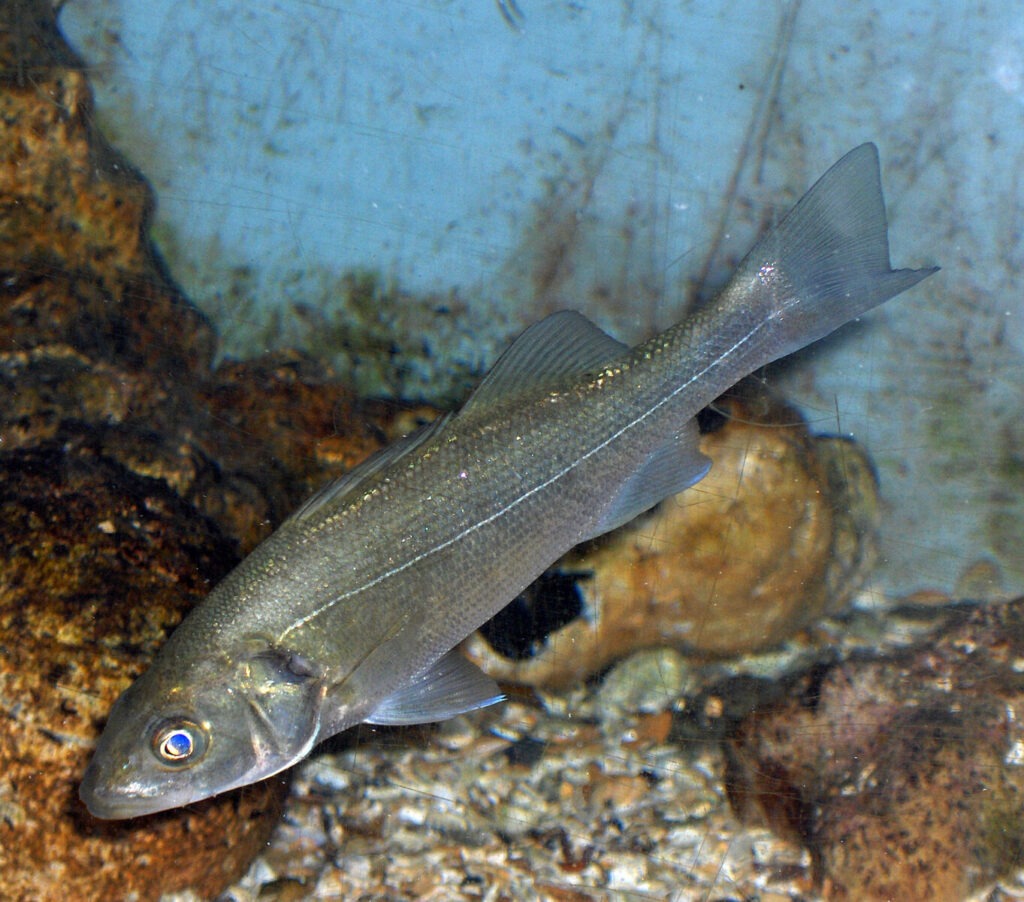
Viewed from the surface, the seabass displays a perfect torpedo shape designed for cutting through turbulent water.
The European Seabass possesses a classic fusiform body shape—elongated, torpedo-like, and moderately compressed laterally. This is the ultimate hydrodynamic design for an active pelagic and coastal swimmer.
They are robustly built, not overly deep-bodied like a snapper or bream. This balanced morphology allows them to hold their ground in the turbulent surf zones of ocean beaches, as well as maneuver deftly through the complicated structures of rocky reefs and kelp beds where they ambush prey.
 3. Head Profile and The Operculum

Notice the sloping forehead and the prominent dark spot on the upper edge of the gill cover.

The rear edge of the gill cover is armed with sharp, backward-pointing defensive spines.
The head of Dicentrarchus labrax makes up a significant portion of its body length. It features a gently sloping, somewhat straight forehead profile that ends in a pointed snout. A key identification marker is the distinct dark, diffuse spot located on the upper edge of the gill cover (operculum).
The operculum itself serves as a primary defense mechanism. The rear edge of the gill cover is armed with two flat, incredibly sharp, backward-pointing spines. Experienced anglers know to handle a thrashing seabass with extreme caution to avoid painful punctures.
 4. The Mouth: A Suction Trap

The seabass is a suction feeder, capable of drastically expanding its mouth cavity.

Bands of tiny, inward-pointing teeth designed to grip slippery prey, not slice it.
The mouth is terminal, large, and slightly superior, meaning the lower jaw protrudes just slightly beyond the upper jaw. When hunting, the seabass utilizes a technique called suction feeding.
By rapidly opening its cavernous mouth and expanding its gill covers, the fish creates a sudden negative pressure vacuum. This literally sucks the unsuspecting prey item into its mouth along with a rush of water. The mouth is lined with villiform teeth—fine, bristle-like teeth acting like Velcro to ensure slippery prey cannot wriggle back out.
 5. Geographic Range and Distribution

Ranging from Norway down the Atlantic coast, and heavily populating the entire Mediterranean and Black Seas.
The European Seabass is endemic to the waters of the eastern Atlantic Ocean and its associated seas. Its natural distribution is vast, spanning from the chilly waters of southern Norway and the British Isles, down the western coast of Europe, and extending as far south as Senegal in West Africa.
However, its most famous and densely populated strongholds are the entire Mediterranean Sea basin and the Black Sea, where it has held immense cultural and economic value since the days of the Roman Empire.
 6. Habitat: The Mediterranean Sea
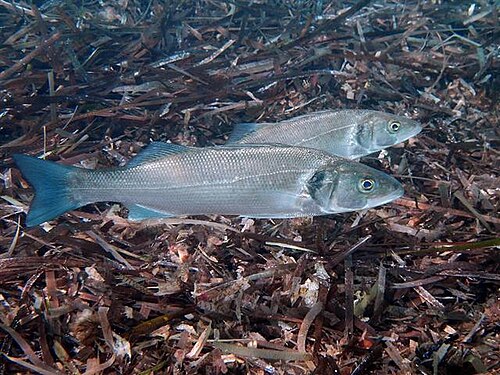
A wild seabass photographed in the crystal-clear waters of Minorca, Spain.

In the Mediterranean, they constantly patrol rocky reefs and Posidonia seagrass meadows.
The warm, highly saline, and relatively calm waters of the Mediterranean provide the ultimate thriving ground for Dicentrarchus labrax. Here, they are the apex predators of the shallow coastal zones.
Because the Mediterranean is a highly competitive, nutrient-poor (oligotrophic) sea, seabass here are exceptionally aggressive and efficient hunters, constantly patrolling the rocky shorelines and ancient sunken ruins looking for careless prey.
 7. The Atlantic Population

A robust specimen sourced from the Belgian Continental Shelf.
The Atlantic population of the European seabass experiences significantly colder temperatures and wilder tidal environments than their Mediterranean counterparts. Fish off the coasts of the UK, Ireland, and Belgium are often highly prized by surfcasters.
Atlantic bass are highly migratory. In the autumn, as coastal waters cool, large shoals migrate southwards or move offshore into deeper, more temperature-stable oceanic waters to overwinter and spawn, returning to the coasts in the spring.
 8. Estuaries and The Euryhaline Advantage

A wild seabass caught near Brest, France, where rivers meet the sea.
The European Seabass is a classic euryhaline species—meaning its kidneys and gills are incredibly efficient at osmoregulation, allowing it to adapt to a vast range of salinities.
A seabass can swim from the hypersaline waters of the open Mediterranean directly into a freshwater river mouth to hunt for eels, and experience no biological shock. Estuaries, where fresh river water mixes with the ocean, are absolutely vital to their lifecycle, providing nutrient-rich hunting grounds and safe nurseries for juveniles.
 9. Coastal Lagoons and Harbors

This large specimen was photographed in Brest harbor, hunting among the piers and boats.
Human-made structures like harbors, breakwaters, and piers provide excellent artificial reefs. Adult seabass frequently invade harbors during high tide to hunt crabs and small mullet hiding among the pilings.
They are bold, opportunistic hunters, taking advantage of the lighting from docks at night to ambush baitfish that are attracted to the glow, making them a favorite target for urban anglers.
 10. Diet and Pack Hunting

A seabass patrolling the shallow, rocky bottom in Cres, Croatia.
Adult European seabass are formidable carnivores. Their absolute favorite prey items are schooling pelagic fish, heavily targeting sardines, sand eels, sprats, and grey mullet. They earn their French name “Sea Wolf” (Loup de mer) from their hunting style.
In the churning white water of a surf beach, they hunt in coordinated packs, driving schools of baitfish into tight balls against the shoreline before violently rushing in to gorge themselves.
Part II: From Larvae to Predator (Chapters 11-20)
 11. Stomach Contents and Gluttony

A whole channel crab found inside a seabass caught by a sport fisher in a river in Tuscany, Italy.
They are not exclusively fish-eaters. A large portion of an adult seabass’s diet consists of cephalopods (squid and cuttlefish) and hard-shelled crustaceans.
As seen in the stomach content analysis above, a seabass will swallow large, heavily armored prey entirely whole. Their stomach acids are incredibly potent, capable of dissolving thick crab carapaces and fish bones rapidly. This opportunistic gluttony dictates the types of lures anglers use in different seasons.
 12. Larval Stage: The Blind Hatchlings

At hatching, larvae are completely blind and their mouths are not yet open. (Source: IFREMER)
The life of this formidable predator begins in an incredibly fragile state. The fertilized eggs drift in the pelagic currents before hatching. Upon hatching, the larvae are microscopic, transparent, and entirely helpless.
An incredible fact about European seabass larvae is that they are completely blind when they hatch, and their mouths are sealed shut. To ensure normal development, especially in aquaculture hatcheries, the beginning of their life is spent in total darkness, surviving purely by absorbing their internal yolk sac.
 13. Larval Development and First Feeding

Around day 5 to 7, the eyes pigment, the mouth opens, and the digestive tract forms.
It is only around day 5 to 7 that the mouth finally opens, the eyes pigment and become functional, and the yolk sac is depleted. At this exact moment, they must immediately transition to active hunting.
Their first meals are microscopic live prey like rotifers or Artemia (zooplankton). In the wild, they drift towards coastal estuaries where this plankton is abundant. If they fail to find food within hours of their mouth opening, they will starve.
 14. The Juvenile Phase (Jungfisch)

A fully formed juvenile showing the typical dark spotting that acts as camouflage in shallow eelgrass beds.
As the larvae continue to grow over several weeks, they undergo metamorphosis. They slowly transform from transparent, tadpole-like creatures into miniature fish, developing scales, a functional swim bladder, and distinct fin rays.
Juvenile seabass often feature distinct black spotting on their upper bodies (as seen in the photo). This spotting helps camouflage them in the shallow seagrass meadows and estuaries where they hide from larger predators. These spots invariably fade and disappear entirely as they reach adulthood.
 15. Maturation and Schooling

As they grow, the spots fade to the solid silver and grey characteristic of the species.
The social behavior of the seabass changes as it ages. Juveniles and young adults (often called “schoolies” by anglers) form tight, highly coordinated shoals. This schooling behavior provides safety from larger predators and allows them to pack-hunt efficiently.
As the seabass grow older and heavier (exceeding 3-4 kg), they tend to become increasingly solitary, territorial, and reclusive. These large, solitary individuals prefer to ambush prey alone from hidden coastal structures rather than expend energy chasing down bait in a pack.
 16. Spawning and Reproduction
Spawning is a massive, highly synchronized event. In the Mediterranean, it occurs during the winter months (December to March). In the colder Atlantic, spawning is slightly later, peaking from February to May.
Adult seabass gather in massive breeding aggregations offshore, typically in deeper water with strong currents. A single large, healthy female can release anywhere from a quarter of a million to over two million eggs in a single season, releasing them directly into the water column to be fertilized externally by attending males.
 17. The Aquaculture Revolution

A perfectly uniform farmed seabass from Cannes, France. Aquaculture has revolutionized the availability of this fish.
The farming of European seabass is a monumental success story in marine agriculture. Historically, the Romans practiced extensive aquaculture by trapping wild juveniles in coastal lagoons (valli), allowing them to grow naturally.
The modern intensive aquaculture boom began in the late 1960s in France and Italy. Scientists successfully mastered the mass-rearing of live prey (rotifers and Artemia) required to feed the blind, fragile larvae, breaking the final bottleneck to commercial farming. Seabass was the first marine non-salmonid species to be commercially cultured in Europe.
 18. Commercial Fishing of Wild Stocks

A magnificent wild specimen caught off the coast of Brest, France. Wild fish command premium market prices.

Wild seabass from the Atlantic are highly sought after by high-end chefs for their superior firm texture.
Commercial fishing for wild seabass is a highly lucrative industry. Fishermen target them using mid-water trawls, gillnets, and, for the highest quality fish, commercial hook-and-line methods which preserve the impeccable quality of the flesh without bruising it in nets.
The winter months, when the fish aggregate in large schools offshore to spawn, have historically been the peak catching season. However, this practice of targeting spawning aggregations led to severe population crashes in the early 21st century, prompting strict EU quotas.
 19. Recreational Angling

A seabass caught from an Italian river using a spoon lure.
For the sport fisherman standing on the rocky, wave-battered coastlines of Ireland, the UK, or France, catching a large wild seabass is considered the ultimate angling achievement. They are renowned for their cunning, their explosive strikes on surface lures, and their powerful, dogged fighting ability.
Anglers spend hours casting topwater poppers and diving minnows into the churning white surf at dawn and dusk. Due to declining wild stocks, a strong “catch and release” ethos has developed among the sport fishing community.
 20. Culinary Prestige
In the culinary world, the European seabass (Branzino) is royalty. Its flesh is brilliantly white, firm yet flaky, with a remarkably delicate, sweet, and mild flavor profile that lacks any overpowering “fishy” taste. It is highly forgiving to cook and exceptionally versatile.
The traditional Mediterranean preparation is a study in minimalism: scaling and gutting the fish, stuffing the cavity with lemon, fresh thyme, and rosemary, and roasting or grilling it whole. Another iconic method is baking the whole fish encased in a thick crust of sea salt, which locks in the moisture perfectly.
Part III: Physiology, Threats, and Research (Chapters 21-30)
 21. FDA Standards and Seafood Fraud

The FDA maintains a Reference Standard Sequence Library for Seafood Identification to prevent fish fraud.
Because of its high market value in the United States and Europe, farmed Branzino is a common target for “seafood fraud” (where a cheaper white fish, like tilapia or swai, is mislabeled and illegally sold as Branzino).
To combat this, the US Food and Drug Administration (FDA) maintains a strict reference standard library, utilizing genetic DNA sequencing and standardized photographic records to guarantee market authenticity and protect consumers and legitimate fishermen.
 22. Sensory Adaptations: The Lateral Line
In blind-visibility conditions during murky, turbulent storms or pitch-black nights, the seabass’s eyes cannot be relied upon. They are equipped with a highly developed sensory organ along the flanks of their body known as the Lateral Line.
This hydraulic neural system reacts instantly to pressure distortions or physical wave frequencies caused by the slightest splash of a prey fish’s tail. The seabass can pinpoint the exact position of a struggling baitfish in total darkness, executing a perfect strike.
 23. Countershading Camouflage

Photographed at Loro Parque, Tenerife. The dark back and white belly provide perfect oceanic camouflage.
The body color of the seabass is a masterpiece of stealth hunting adaptation, utilizing a biological coloration concept called countershading. Their ventral (belly) side is pale white or bright silver, while their back is a dark grayish-blue or metallic bronze.
If prey looks up from below, the white belly blends with the bright sunlight breaking through the surface. Conversely, if an eagle or angler looks down from above, the dark back blends perfectly with the dark color of the reef or deep sea abyss.
 24. IFREMER and Larval Research
Organizations like the French Research Institute for Exploitation of the Sea (IFREMER) dedicate immense resources to studying the microscopic early life stages of the seabass.
Understanding exactly how temperature, salinity, and darkness affect the survival rates of the blind larvae during their first 10 days is critical. This research not only optimizes commercial aquaculture yields but also helps marine biologists understand how climate change and warming ocean temperatures might impact wild spawning success.
 25. Predators and Natural Threats

A wild seabass photographed in Sardinia, Italy. In shallow water, they are exposed to aerial and marine predators.
While an adult seabass is a top-tier predator in the coastal zone, it is not immune to predation itself. As juveniles in the estuaries, they face a gauntlet of threats from larger predatory fish, cormorants, and herons.
As adults, their primary non-human predators are marine mammals. Grey seals and bottlenose dolphins are known to actively hunt adult seabass. In deeper waters, large pelagic sharks may also pick off seabass that venture off the continental shelf during their winter migrations.
 26. The Mechanics of the Gills
The seabass is a highly active, fast-swimming predator, which demands a massive supply of oxygen to its red muscle tissues. Beneath the armored operculum lie the highly efficient gills.
It uses buccal pumping to actively gulp water and force it over the bright red gill filaments. On the inner curve of the gill arches are the gill rakers—comb-like structures that prevent debris, and the thrashing prey items they swallow whole, from escaping out the side of the head or damaging the delicate respiratory filaments.
 27. Conservation and The “Vulnerable” Debate

A European seabass safely housed in an aquarium.
Globally, the IUCN lists the European Seabass as Least Concern, largely owing to the massive, stable populations sustained by the booming aquaculture industry.
However, this broad classification masks a severe crisis facing wild Atlantic stocks. Overfishing, particularly commercial targeting of pre-spawning aggregations, led to a near-collapse in the 2010s. In response, the European Union implemented emergency measures, including strict catch limits for recreational anglers and complete bans on commercial netting during the crucial winter spawning months.
 28. Sex Determination and Temperature
A fascinating aspect of seabass biology, discovered through extensive larval research, is that sex determination is not entirely genetic. It is heavily influenced by the temperature of the water during the early larval and juvenile stages.
Warmer water temperatures during early development tend to produce a significantly higher ratio of males. In aquaculture, where females are preferred because they grow larger and faster, controlling the temperature of the nursery tanks during these crucial first weeks is essential for a profitable harvest.
 29. Genetic Escapes from Farms
With millions of seabass raised in offshore sea-cages in the Mediterranean, escapes during severe storms are inevitable. This poses a unique ecological concern known as genetic introgression.
Farmed seabass have been selectively bred over generations for rapid growth, docility, and disease resistance, rather than wild survival skills. When these farmed escapees interbreed with wild populations, they can dilute the wild genetic pool, potentially reducing the overall fitness and survival capacity of future wild generations.
 30. Summary FAQ: The Future of the Seabass
Is European Seabass the same as Chilean Sea Bass?
No. “Chilean Sea Bass” is a marketing name for the Patagonian Toothfish, a deep-water, slow-growing species from the Antarctic. The European Seabass (Branzino) is a completely different, faster-growing coastal species.
Are wild stocks recovering?
Yes, slowly. After severe population crashes in the early 2000s, strict EU quotas on commercial netting during spawning seasons and catch-limits for recreational anglers have allowed wild Atlantic populations to begin stabilizing.
Why are farmed seabass usually all the same size?
Modern aquaculture carefully controls the feeding and environment to harvest the fish exactly when they reach “portion size” (usually around 400-600 grams), which is perfect for serving whole in restaurants.
Explore our trusted network of partner websites covering directories, encyclopedias, marketplaces, education, and finance.
- This digital encyclopedia is created solely as an educational reference material detailing the biological and commercial impacts of the European Seabass.
- All included image multimedia content is distributed from the free open-license directory (GNU/Creative Commons Attribution) belonging to the worldwide Wikimedia Commons database.
- Marine statistics, taxonomy data, and aquaculture practices discussed are based on scientific consensus from institutions like IFREMER and the IUCN.
About the Drafting Team: Atechsur.org Marine Experts
The scientific biology editorial board of Atechsur.org proactively provides accurate, in-depth scientific reports with a dedication to engaging, humanistic language to promote sustainable aquaculture and comprehensive ocean protection globally.
© 2026 – Atechsur.org – Complete European Seabass Encyclopedia (Chapters 1 – 30)
Dicentrarchus labrax • Least Concern • Updated: April 1, 2026