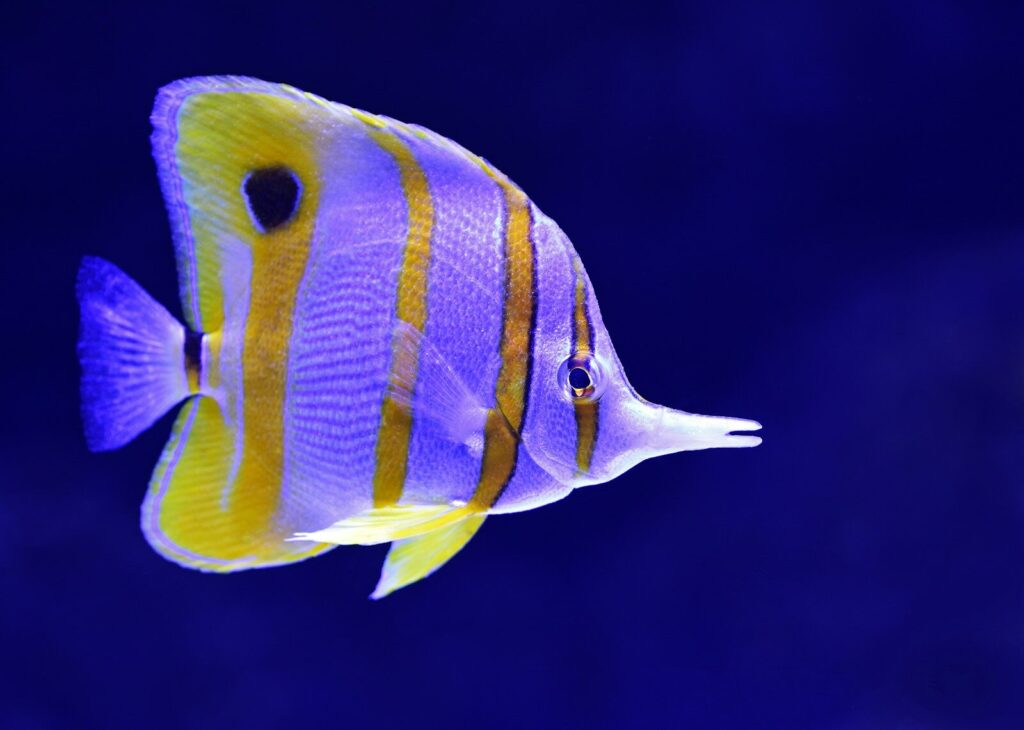
🐠 Jewels of the Reef: The Butterflyfish Encyclopedia
An ultra-comprehensive 50-chapter guide exploring the vibrant biology, complex ecology, and critical conservation of the Family Chaetodontidae.
✏️ Written & Curated by the Atechsur.org Marine Biology Team | Last Updated: March 27, 2026

Among the myriad of creatures that inhabit the world’s tropical oceans, few are as universally recognized and admired as the Butterflyfish (Family Chaetodontidae). These vibrantly colored, highly specialized marine fishes are the undisputed jewels of the coral reef, fluttering gracefully among the stony corals in a manner that earned them their delicate name.
However, beneath their stunning patterns and seemingly peaceful demeanor lies a complex biology adapted for survival in one of the most competitive environments on Earth. In this exhaustive 50-chapter encyclopedia, we will dissect every aspect of their existence, from the evolutionary function of their false “eye-spots” to their highly specific diets, and the looming threats they face from global coral bleaching.
- Bristle Teeth: The family name Chaetodontidae translates to “hair-tooth,” referring to the brush-like rows of tiny teeth used to scrape polyps from hard coral.
- Masters of Illusion: Many species feature a dark vertical band through their true eye and a prominent “false eye” near their tail to confuse predators about their heading.
- Monogamous Pairs: Certain butterflyfish species are known to form long-lasting, monogamous pairs that patrol their reef territory together for years.
- Diurnal Feeders: They are strictly active during the day (diurnal) and seek shelter deep within reef crevices at night, often dulling their bright colors while sleeping.
The butterflyfishes comprise the family Chaetodontidae, a diverse and prominent group within the order Perciformes. The family name is derived from Ancient Greek: chaite meaning “hair” or “bristle,” and odous meaning “tooth.”
This taxonomic naming perfectly encapsulates their most vital anatomical adaptation. Unlike predatory fish with sharp, grasping teeth, butterflyfish possess specialized jaws lined with rows of tiny, bristle-like teeth, enabling them to delicately nip soft coral polyps and extract tiny invertebrates from deep within rocky crevices without damaging their own mouths.
Fossil records suggest that the ancestors of modern butterflyfish began diversifying heavily during the Eocene epoch, roughly 30 to 40 million years ago. Their evolution is inextricably linked to the proliferation of modern, shallow-water coral reef ecosystems.
As coral reefs expanded across the ancient Tethys Sea, these fish evolved their highly compressed bodies and specialized snouts to exploit the complex, three-dimensional labyrinth of the reef, adapting alongside the very corals they feed upon.
Butterflyfish are often confused by novice snorkelers with their close relatives, the marine Angelfish (family Pomacanthidae). Both share vivid colors, similar habitats, and laterally compressed, disk-like bodies.
However, there is one definitive anatomical difference: marine angelfish possess a prominent, sharp, backward-pointing spine at the base of their gill cover (preopercle). Butterflyfish completely lack this preopercular spine, a primary trait biologists use to quickly separate the two families in the field.

Notice the extreme lateral compression of the body, resembling a swimming disc.
The hallmark of the Chaetodontidae family is their extreme lateral compression. Their bodies are essentially flat from side to side, presenting a large, rounded, or oval profile when viewed from the side, but appearing almost paper-thin when viewed head-on.
This shape is not built for high-speed, open-ocean swimming. Instead, it offers incredible maneuverability, allowing the fish to pivot on a dime, flutter delicately, and slip into narrow, jagged coral crevices to escape predators or hunt for hidden food.

Bold, high-contrast patterns are a signature of the family.
Butterflyfish boast some of the most striking color palettes in the animal kingdom, predominantly featuring brilliant yellows, stark whites, deep blacks, and occasional flashes of orange or blue. These colors are not merely for show; they serve complex ecological functions.
Within the busy, colorful backdrop of a sunlit coral reef, these bold, contrasting patterns can act as a form of disruptive camouflage, breaking up the fish’s outline. Additionally, specific patterns serve as species-recognition markers, allowing them to identify mates or rivals from a distance.

A prominent black spot on the rear dorsal fin acts as a “false eye.”
A classic defensive adaptation seen in many butterflyfish species, such as the Threadfin Butterflyfish (Chaetodon auriga), is the presence of a distinct, large black spot near the tail or on the rear dorsal fin. This is called an eyespot or ocellus.
Coupled with a dark vertical band that hides their actual eye, this creates a brilliant optical illusion. A predator (like a moray eel or grouper) naturally aims for the head to prevent the prey’s escape. By confusing the predator about which end is the head, the butterflyfish gains a crucial split-second to dart away in the opposite direction when struck.

The elongated snout acts like forceps to extract prey from deep crevices.
While many butterflyfish have relatively short, pointed snouts, others have evolved extreme facial modifications. The most famous example is the Yellow Longnose Butterflyfish (Forcipiger flavissimus).
Its snout has elongated into a tube-like structure resembling long tweezers or forceps. This specialized anatomical tool allows the fish to reach deep into the tiny, complex holes of branching corals to extract small crustaceans, worms, and inaccessible polyps that other, shorter-snouted fish cannot reach.
Unlike fish built for speed, which often have deeply separated dorsal fins, the butterflyfish features a single, continuous dorsal fin that runs along the majority of its back.
The front portion of this fin is supported by sharp, rigid spines (usually 6 to 16), which act as a deterrent against being swallowed by larger predators. The rear portion smoothly transitions into soft, flexible rays, aiding in their precise, fluttering swimming style.
Butterflyfish are strictly diurnal, meaning they are active during the day. When the sun sets, they seek refuge deep within the reef structure to sleep and avoid nocturnal predators like moray eels.
During this resting phase, a remarkable physiological change occurs. They often exhibit nocturnal color fading. Their bright yellows and stark whites dull considerably, and some species even develop dark, mottled, or blotchy patterns across their flanks, allowing them to blend perfectly into the dark shadows of the coral rock while they rest.
The family Chaetodontidae is predominantly found in tropical and subtropical waters around the globe. They are circumtropical, with populations existing in the Atlantic, Indian, and Pacific Oceans.
However, the highest concentration of biodiversity by far is located in the Indo-Pacific region, particularly within the Coral Triangle (encompassing Indonesia, the Philippines, and Papua New Guinea), where dozens of distinct species can be observed on a single healthy reef.
Butterflyfish are quintessential shallow-water dwellers. They are most abundantly found in the sunlit upper zones of coral reefs, typically between depths of 1 meter to 20 meters (3 to 65 feet), where coral growth is most vigorous.
While the vast majority are shallow-water species, a select few are known to inhabit deeper, mesophotic reefs (the “twilight zone”), sometimes descending to depths exceeding 100 meters (330 feet), where they feed on deep-water sponges and hydroids.

Photographed in Sharm el-Sheikh, Egypt.
One of the most striking and frequently photographed species is the Bluecheek Butterflyfish (Chaetodon semilarvatus), also known as the Golden or Masked Butterflyfish. It is immediately identifiable by its bright yellow body adorned with vertical dark lines and, most notably, a large, dusky blue patch covering its gills and eyes, resembling a mask.
This species is relatively large for the family, capable of reaching lengths of up to 23 cm (9 inches). It is a highly sought-after subject for underwater photographers due to its vivid colors and relatively calm demeanor.

C. semilarvatus is exclusively found in the Red Sea and the Gulf of Aden.
Unlike some widely distributed species, the Bluecheek Butterflyfish (C. semilarvatus) is endemic to a very specific region: the Red Sea and the neighboring Gulf of Aden. You will not find this particular species naturally occurring anywhere else in the world’s oceans.
This high level of endemism makes them a flagship species for the Red Sea’s unique coral reef ecosystems, often featuring prominently in dive tourism materials for regions like Aqaba and El Gouna in Egypt.

A pair of Bluecheek Butterflyfish navigating Elphinstone Reef, Egypt.

Many butterflyfish are noted for their strong monogamous pair bonds.
One of the most endearing behavioral traits of many butterflyfish, particularly evident in the Bluecheek Butterflyfish, is their tendency to form monogamous pairs. Once a male and female bond, they often remain together for life, which can span up to 10 years or more.
These pairs can be seen swimming synchronously over the reef, rarely straying more than a few feet from one another. They defend their territory jointly and forage together, demonstrating a level of social partnership relatively rare among reef fishes.
Despite their delicate appearance, butterflyfish can be fiercely territorial. A bonded pair will often lay claim to a specific coral head or a patch of reef, treating it as their exclusive feeding ground.
If another butterflyfish of the same species encroaches on this territory, the resident pair will vigorously chase the intruder away. This territorial behavior ensures that the pair has exclusive access to the slow-growing coral polyps within their domain.

Photographed in Kona, Hawaii. The dark facial mask gives it its common name.
Another iconic member of the family is the Raccoon Butterflyfish (Chaetodon lunula). Found throughout the Indo-Pacific, from East Africa to Hawaii, it is easily identified by the dark, mask-like band across its eyes and a yellowish-orange body.
Interestingly, unlike many strictly diurnal butterflyfish, the Raccoon Butterflyfish is known to be occasionally active at night, hunting for benthic invertebrates under the cover of darkness.

Photographed at Bangsaen Aquarium. Note the pronounced false eye spot on the dorsal fin.
The Copperband Butterflyfish (Chelmon rostratus) is arguably one of the most recognizable fish in the marine aquarium trade. Characterized by its elongated snout and striking vertical orange/copper bands against a white body, it features a textbook example of a false eyespot on its upper rear flank.
In the wild, they are solitary or pair-forming hunters that specialize in picking small anemones, notably the pest species Aiptasia, and tube worms out of deep coral crevices.
Features a distinct cross-hatch pattern.

One of the largest species in the genus, easily identified by its vertical black lines.
The diversity within the genus Chaetodon is staggering. The Latticed Butterflyfish (C. rafflesii) displays a complex, grid-like pattern across its flanks, providing excellent camouflage among branching corals. It is primarily a corallivore (coral eater).
In contrast, the Lined Butterflyfish (C. lineolatus) holds the title of the largest species in the genus, reaching up to 30 cm (12 inches). Its prominent vertical black lines help it blend into the vertical shadows cast by towering coral structures.

Source: Fishes of Zanzibar by G.H. Ford. Early naturalists were captivated by their striking patterns.
The beauty of the butterflyfish has captivated naturalists and artists for centuries. Long before underwater photography, species like Chaetodon semilarvatus were meticulously documented through detailed scientific illustrations.
Works such as the 1866 publication Fishes of Zanzibar: Acanthopterygii feature exquisite hand-drawn lithographs that helped early European marine biologists classify and understand the staggering biodiversity of the Indo-Pacific and Red Sea reefs.
Butterflyfish diets are highly specialized, and they can generally be divided into three main categories. The first is the Obligate Corallivore. These species feed almost exclusively on the live tissue (polyps) of hard corals.
Because their diet is so restricted, obligate corallivores are considered “indicator species.” Their presence, or absence, provides marine biologists with an immediate visual health check of a reef system. If the coral dies, these specific butterflyfish are the first to vanish.
The second dietary group is the Facultative Corallivore. These species do consume coral polyps, but they are not entirely dependent on them for survival. They supplement their diet with a variety of other food sources, such as small anemones, polychaete worms, and algae.
This dietary flexibility makes them much more resilient to environmental changes. If a bleaching event damages the local coral, facultative species can shift their focus to grazing on the algae that subsequently colonize the dead coral skeletons.
The third major dietary group consists of the Benthic Invertebrate Feeders. These butterflyfish, such as the Copperband (Chelmon rostratus) and the Raccoon (Chaetodon lunula), largely ignore hard coral polyps.
Instead, they focus their attention on hunting small, non-coral invertebrates hiding on the sea floor (the benthos). They use their pointed snouts to extract small crustaceans, tube worms, and nudibranchs from tight crevices, playing a crucial role in controlling populations of reef micro-predators.
While rare within the family, a small number of butterflyfish species belong to a fourth dietary category: Planktivores. These species, such as the Pyramid Butterflyfish (Hemitaurichthys polylepis), swim well above the coral structures in the open water column.
Rather than picking at the reef, they face into the ocean currents and snap up microscopic zooplankton drifting by. Because of this diet, planktivorous butterflyfish often form large, loose aggregations (schools) rather than strictly adhering to the monogamous pairs typical of bottom-feeding species.
An interesting, though less common, behavior observed in some juvenile butterflyfish is “cleaning.” Similar to dedicated cleaner wrasses, young butterflyfish will occasionally approach larger pelagic fish or resident groupers and carefully pick off dead skin and external parasites.
While they generally abandon this behavior as they reach adulthood and their dietary preferences shift, this early cleaning phase provides juveniles with a safe, reliable food source while reducing their chances of being eaten by the larger “client” fish.
Butterflyfish reproduce through a process known as pelagic spawning. They do not build nests or guard their young like cichlids or clownfish. Instead, bonded pairs will rise rapidly from the reef toward the surface, often at dusk, in a synchronized “spawning rush.”
At the apex of this rush, they simultaneously release thousands of buoyant eggs and sperm into the water column. The fertilized eggs become part of the planktonic drift, carried away by ocean currents, ensuring the genetic dispersal of the species across vast oceanic distances.
The larval development of the Chaetodontidae family is entirely unique in the fish world. After hatching, the larvae enter a specialized stage called the Tholichthys stage, which lasts for several weeks or even months as they drift in the open ocean.
During this phase, the larvae are encased in a tough, bony armor of enlarged head plates, which provides defense against tiny predators in the plankton layer. As they mature and prepare to settle onto a reef, they undergo a rapid metamorphosis, absorbing these bony plates and developing their iconic disc-like shape and vibrant colors.

A cross between the Sunset butterflyfish (C. pelewensis) and the Spotband butterflyfish (C. punctatofasciatus).
An intriguing aspect of butterflyfish genetics is their propensity for hybridization in the wild. When the geographic ranges of two closely related species overlap (a hybrid zone), they will occasionally interbreed, producing offspring that exhibit a blend of colors and patterns from both parents.
The image above showcases a known hybrid between a Sunset butterflyfish and a Spotband butterflyfish. Studying these hybrids provides evolutionary biologists with critical data regarding species divergence and the porous nature of genetic boundaries in complex marine environments.
As the oceans warm due to climate change, mass coral bleaching events have become increasingly frequent. For obligate corallivore butterflyfish, this is an existential crisis. Without live coral polyps to eat, these populations rapidly collapse.
Even for facultative feeders, the loss of complex coral structure means a loss of shelter from predators. Biologists extensively monitor butterflyfish populations during and after bleaching events; a sharp decline in their numbers is one of the clearest and most immediate indicators of a dying reef ecosystem.

Species like the Threadfin are popular, but challenging, aquarium subjects.
Due to their unparalleled beauty, butterflyfish are highly sought after by the global marine aquarium trade. However, they are notoriously difficult to keep in captivity. Because many species are obligate corallivores, providing them with their highly specialized diet in a glass tank is nearly impossible for average hobbyists.
As a result, many wild-caught butterflyfish perish shortly after entering the trade. Conservationists advocate strongly that only species known to readily accept substitute commercial foods (like the Raccoon or Threadfin butterflyfish) should be considered for aquariums, and ideally only those bred in captivity.
While the genus Chaetodon contains the vast majority of butterflyfish, other genera are equally striking. The genus Heniochus, commonly known as Bannerfishes, are characterized by a dramatically elongated fourth dorsal spine that trails behind them like a long, white pennant or banner.
Often boasting stark black and white vertical banding with yellow accents, they are frequently confused with the Moorish Idol (Zanclus cornutus), which belongs to an entirely different family. Bannerfishes are generally hardier and more adaptable in their diets than typical Chaetodon species.
Despite their agility and defensive spines, butterflyfish are a crucial food source for many larger reef predators. Ambush predators like groupers and snappers frequently target them, lying in wait within the coral matrix.
Moray eels are a significant threat, particularly at night when the diurnal butterflyfish are sleeping in crevices. Open-water predators like jacks (trevally) and reef sharks will also hunt them if they venture too far from the safety of the complex coral structure.
While often thought of as silent, the coral reef is a noisy environment, and butterflyfish contribute to the acoustic landscape. Research has shown that certain species of butterflyfish can produce distinct sounds, particularly during territorial disputes or mating rituals.
These sounds, often described as low-frequency clicks, grunts, or popping noises, are generated by specialized muscles vibrating against their swim bladder. This acoustic communication is a vital tool for maintaining pair bonds and defending territory in the visually cluttered reef environment.
Because of their incredibly tight evolutionary link with hard corals, marine biologists use butterflyfish populations as bioindicators. By conducting simple visual surveys of the diversity and abundance of butterflyfish species on a given reef, scientists can accurately assess the overall health of the coral ecosystem.
A reef teeming with diverse, obligate corallivore butterflyfish is almost certainly a thriving, healthy system. Conversely, a reef where these fish have vanished is likely suffering from severe environmental stress, disease, or overfishing.
Currently, the IUCN Red List classifies the vast majority of butterflyfish species as Least Concern. Their widespread distribution across the Indo-Pacific provides a buffer against total extinction.
However, scientists warn that this status may be misleading. As climate change accelerates coral reef destruction globally, the specific, localized populations of obligate corallivores are highly vulnerable to rapid decline, even if the species as a whole survives in isolated pockets.
Unlike tuna or grouper, butterflyfish hold practically zero value in commercial food fisheries due to their small size and bony structure. However, their economic value alive is immense.
They are a cornerstone species for the multi-billion-dollar global marine ecotourism industry. Snorkelers and scuba divers travel from around the world to locations like the Great Barrier Reef or the Red Sea specifically to witness the vibrant colors and graceful movements of fish like the Bluecheek Butterflyfish, driving vital revenue to coastal communities.
Butterflyfish rely heavily on their pectoral fins for locomotion, rather than just their tail (caudal) fin like a shark. This form of swimming, known as labriform locomotion, allows them to make precise, highly controlled movements.
They can hover motionless, swim backward, and pivot instantly around coral branches. The tail is generally reserved for sudden bursts of speed when evading a predator’s strike.

Species like the Vagabond Butterflyfish (Chaetodon vagabundus) often congregate in mixed-species groups in French Polynesia.
The Vagabond Butterflyfish (Chaetodon vagabundus) is one of the most common and widely distributed species in the Indo-Pacific. Featuring a distinctive chevron pattern and a dark vertical band through the eye, it is a hardy, adaptable facultative corallivore.
Its ability to consume algae and small benthic invertebrates, alongside coral polyps, allows it to thrive in degraded reef environments where obligate corallivores have perished.
When threatened, butterflyfish employ a specific defensive posture. Rather than simply swimming away, they will often turn their broad side toward the predator, maximizing their apparent size.
Simultaneously, they will fully erect their sharp dorsal and anal spines, presenting a spiky, difficult-to-swallow disc. If the predator approaches the “head” (which is actually the false eyespot on the tail), the butterflyfish darts away in the opposite direction.
Beyond coral bleaching, ocean acidification poses a severe, invisible threat. As the ocean absorbs more CO2, its pH drops. Studies indicate that this altered chemistry affects the neurological functions of reef fishes, including butterflyfish.
Acidification can impair their sense of smell, making it difficult for them to locate preferred coral food sources or detect the chemical alarm cues of approaching predators, severely reducing their survival rates.
Butterflyfish are integral to the complex web of reef symbiosis. While they prey on coral, their grazing can actually be beneficial in moderation, removing diseased or damaged tissue.
They also interact constantly with other reef residents, occasionally associating with schools of herbivorous surgeonfish to gain access to highly defended territories controlled by aggressive damselfish.
The Teardrop Butterflyfish (Chaetodon unimaculatus) is easily identified by its bright yellow body and the single, large black “teardrop” spot on its upper flank. This species is particularly interesting because it is one of the few butterflyfish known to feed heavily on soft corals and leather corals, rather than strictly stony (scleractinian) corals.
Despite their small size and the perilous nature of the coral reef, butterflyfish can live surprisingly long lives if they manage to evade predation. Scientific studies analyzing the otoliths (ear bones) of various species indicate that many can live for 7 to 10 years in the wild.
Given their monogamous nature, this means bonded pairs may patrol the exact same patch of reef together for nearly a decade.
The Foureye Butterflyfish (Chaetodon capistratus) takes the false eyespot defense to the extreme. Native to the Western Atlantic and Caribbean, it features a massive, white-ringed black spot on its rear flank that is significantly larger and more prominent than its actual eye.
This striking contrast is incredibly effective at confusing Caribbean predators like the Great Barracuda.
Like all teleost fishes, butterflyfish possess a lateral line system. This network of sensory pores runs along their flanks and detects minute changes in water pressure and vibrations.
This allows the butterflyfish to “feel” the approach of a stealthy predator from behind or navigate through complex, jagged coral formations even in turbulent, murky water following a storm.
The pelagic spawning strategy of butterflyfish relies on overwhelming numbers. By releasing hundreds of thousands of eggs, they account for the staggering mortality rate of the open ocean.
Over 99.9% of butterflyfish eggs and larvae are consumed by filter-feeding whales, manta rays, and other plankton-eaters before they ever have the chance to develop the Tholichthys armor and settle onto a reef.
As natural coral reefs decline, artificial reefs (such as sunken ships or purpose-built concrete structures) have become important secondary habitats. Butterflyfish are often among the first ornamental fish to colonize these new structures, provided there is sufficient growth of algae, sponges, and eventually, hard corals to sustain their diets.
The Chevron Butterflyfish (Chaetodon trifascialis) is easily distinguished by the prominent V-shaped (chevron) markings pointing toward its head. This species is fiercely territorial and is an obligate corallivore, strongly preferring the polyps of Acropora table corals.
Despite their ability to dull their colors at night, butterflyfish remain highly vulnerable when sleeping. Invertebrate predators like large octopuses and nocturnal hunters like Moray Eels actively search coral crevices using scent and touch, easily bypassing the butterflyfish’s daytime visual defenses.
The future of the butterflyfish is inextricably bound to the fate of the world’s coral reefs. The implementation of Marine Protected Areas (MPAs) that limit destructive fishing practices and anchor damage is crucial.
However, the overarching threat of global climate change must be addressed to preserve the delicate, calcium-carbonate ecosystems upon which these magnificent “jewels of the reef” depend for their absolute survival.
What do butterflyfish eat?
Their diet varies by species, but generally includes hard coral polyps, small anemones, tiny crustaceans, and marine worms. Some species are highly specialized and eat only specific types of coral.
Why are they called butterflyfish?
They earned their name due to their bright, vividly colored, and heavily patterned bodies, combined with their delicate, fluttering, highly maneuverable swimming style around the coral reefs, much like butterflies in a garden.
Can butterflyfish be kept in home aquariums?
While extremely beautiful, they are generally considered very difficult to keep in captivity. Many species will starve to death in an aquarium because they require a constant supply of live coral polyps to survive.
Explore our trusted network of partner websites covering directories, encyclopedias, marketplaces, education, and finance.
- This digital documentation is created solely as basic reference material for marine biology education and the observation of coral reef wildlife.
- All included image multimedia content is purely distributed from the free open-license directory (Creative Commons) belonging to the worldwide Wikimedia Commons database and marine photographers.
- Conservation status information refers to the verified assessments by the IUCN Red List.
About the Drafting Team: Atechsur.org Biology Experts
The scientific biology editorial board of Atechsur.org proactively provides accurate, in-depth scientific reports with a dedication to engaging, humanistic language to promote a future of improved marine conservation and sustainable coral ecosystems globally.
© 2026 – Atechsur.org – Complete Butterflyfish Encyclopedia Database (Chapters 1 – 50)
Chaetodontidae • Reef Indicator Species • Updated: March 27, 2026